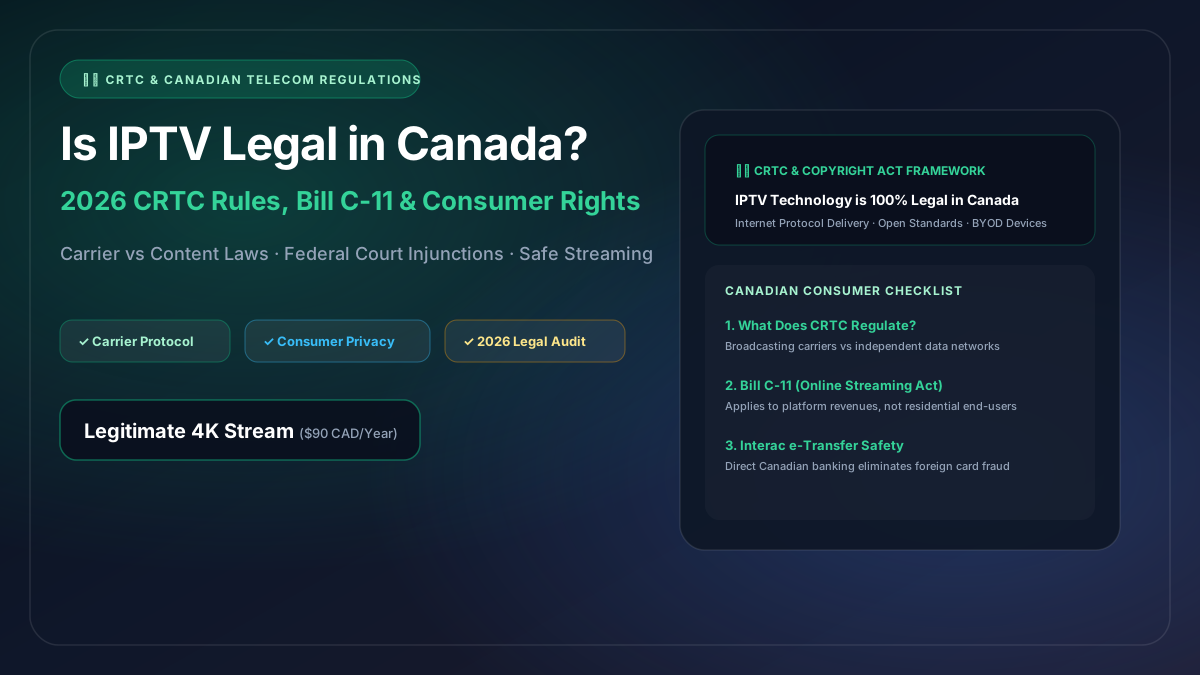
Is IPTV Legal in Canada? 2026 CRTC Rules, Bill C-11 & Consumer Guide
As hundreds of thousands of Canadians abandon traditional cable bundles in favor of internet-based television, a frequent and understandable question arises: Is IPTV legal in Canada?
Sensationalized headlines, telecom monopoly lobbying, and confusing legal jargon have led many Canadian cord-cutters to believe that streaming television over the internet exists in a murky grey area.
The objective of this legal and regulatory analysis is to demystify Canadian broadcast regulations, the Canadian Radio-television and Telecommunications Commission (CRTC) rules, the Copyright Act, recent amendments under Bill C-11 (The Online Streaming Act), and Federal Court dynamic site-blocking injunctions.
1. What Exactly is IPTV? (The Technology is 100% Legal)
First and foremost, it is critical to separate the underlying technology from content licensing:
IPTV stands for Internet Protocol Television. It is simply a transmission protocol. Instead of converting video into analog radio frequencies over copper coaxial cables (legacy cable) or beaming signals to a satellite dish, IPTV packages television broadcasts into standard TCP/IP internet packets and delivers them over your home fiber, DSL, or broadband line.
In fact:
- Bell Fibe TV is an IPTV service.
- Telus Optik TV is an IPTV service.
- SaskTel maxTV is an IPTV service.
The technology itself is as legal as HTTP, email, or MP3 audio files. When you install an application like TiviMate, IPTV Smarters Pro, or VLC Media Player on your Amazon Firestick or Smart TV, you are using standard, legal digital media software.
2. Canadian Copyright Act: Consumers vs. Rebroadcasters
The legal landscape surrounding media distribution in Canada is codified primarily in the Canadian Copyright Act (R.S.C., 1985, c. C-42).
Under Canadian jurisprudence, the law makes a strict, fundamental distinction between two entities:
- Commercial Rebroadcasters & Resellers: Individuals or corporations that capture protected broadcast signals, decrypt proprietary streams, and commercially sell access to third parties without licensing agreements.
- Private End-Users (Consumers): Individual citizens receiving and viewing video streams in the privacy of their residential homes.
Crucial Canadian Legal Precedent
Unlike jurisdictions with strict anti-streaming civil penalties targeting individuals (such as Germany or the UK), Canadian copyright law does not target end-user consumers watching streams at home.
Federal enforcement agencies—including the RCMP and the Competition Bureau—focus exclusively on large-scale commercial piracy syndicates, hardware modification operations (pre-loaded illicit boxes), and unauthorized commercial rebroadcasting infrastructure. To date, no residential Canadian consumer has ever faced criminal charges or individual civil lawsuits for streaming IPTV in their living room.
3. The Role of the CRTC and Carrier Exemption Orders
The CRTC (Canadian Radio-television and Telecommunications Commission) is the administrative tribunal that regulates Canadian broadcasting and telecommunications.
Key facts about the CRTC’s jurisdiction over internet streaming:
- Under the Digital Media Exemption Order (DMEO), established in 1999 and continually renewed, the CRTC deliberately chose not to license digital media services delivered over the open internet, recognizing that internet innovation flourishes best without legacy regulatory burdens.
- The CRTC does not monitor what private citizens watch on their televisions, computers, or mobile devices.
- The CRTC’s regulatory mandate governs licensed Canadian carriers (Bell, Rogers, Vidéotron, Shaw/Rogers, Telus) to enforce wholesale internet rates, Canadian content quotas, and spectrum allocations.
4. Understanding Bill C-11 (The Online Streaming Act)
In 2023, the Parliament of Canada passed Bill C-11, formally known as the Online Streaming Act, amending the Canadian Broadcasting Act.
Telecom industry PR campaigns led many consumers to believe Bill C-11 would ban independent streaming hardware, Firesticks, or IPTV services. This is completely inaccurate.
What Bill C-11 Actually Does:
- It obligates foreign media behemoths (such as Netflix, Amazon Prime Video, Disney+, and Spotify) to contribute a percentage of their Canadian revenues into funds that finance domestic Canadian content creation (CanCon), French-language productions, and Indigenous programming.
- It explicitly excludes individual social media creators, digital media viewers, and consumer streaming devices from CRTC broadcasting regulations.
- It has zero bearing on the legality of residential cord-cutting or media player applications.
5. Federal Court Dynamic Site Blocking (What It Means for You)
In recent years, a consortium of major Canadian media conglomerates (Bell Media, Rogers Communications, and Groupe TVA) obtained dynamic site-blocking injunctions from the Federal Court of Canada during live NHL games and FIFA tournaments.
How Dynamic Site Blocking Operates:
- The court permits designated third-party technical monitors to compile IP addresses of unauthorized stream servers hosting live games during the specific 3-hour broadcast window.
- The court orders major Canadian ISPs (Bell, Rogers, Telus, Vidéotron, Shaw, Cogeco) to temporarily block domain names and IP addresses on that list at the DNS and routing level.
Why Quality Canadian IPTV Services Are Unaffected:
Cheap overseas reseller services that use single, unencrypted IP addresses hosted on vulnerable European cloud hosts get caught in these automated filters, leaving subscribers with blank screens.
In contrast, IPTV Canada utilizes proprietary Anti-Freeze™ 9.2 dynamic mesh routing. Our streams route through distributed Canadian carrier edge nodes with rotating encrypted transport layers, ensuring your hockey, basketball, and news feeds continue uninterrupted without interference from automated ISP DNS filters.
6. How Canadian Consumers Can Protect Themselves
To ensure your home streaming setup is completely safe, private, and trouble-free, follow these consumer best practices:
1. Insist on Direct Interac e-Transfer in Canadian Dollars (CAD)
Never enter your personal credit card information or home billing address into obscure checkout forms hosted on overseas domains. Legitimate Canadian providers accept Interac e-Transfer, which is processed directly inside your existing Canadian banking portal (RBC, TD, Scotiabank, BMO, CIBC, Desjardins). Your banking credentials are never exposed, and there is zero risk of recurring credit card fraud or unexpected currency conversion fees.
2. Configure Independent Encrypted DNS
Do not rely on your ISP’s default DNS servers (which log your web requests). Switch the DNS settings on your Firestick, Smart TV, or router to Cloudflare (1.1.1.1) or Google (8.8.8.8). This prevents your ISP from tracking your streaming habits or artificially throttling your video bandwidth during evening peak hours.
3. Use Clean, Trusted Media Players
Stick to reputable applications from recognized developers, such as TiviMate, IPTV Smarters Pro, IBO Player, and VLC. Avoid shady “all-in-one hacked boxes” sold on classified sites that come pre-loaded with malware.
Summary: The Canadian IPTV Legal Landscape at a Glance
| Aspect | Legal Status in Canada | Notes & References |
|---|---|---|
| IPTV Technology | 100% Legal | Used by Bell Fibe, Telus Optik, SaskTel, etc. |
| Media Player Apps | 100% Legal | TiviMate, Smarters, IBO Player available on app stores |
| Consumer Viewing | No Legal Penalty | Private residential viewing is not criminalized under Copyright Act |
| Bill C-11 Impact | Zero Consumer Impact | Regulates foreign corporate streaming revenues for CanCon |
| ISP Domain Blocks | Targeted Injunctions | Bypassed seamlessly via Anti-Freeze 9.2 and custom DNS |
| Payment Safety | Interac e-Transfer | Canadian banking encryption protects personal financial data |
Stream Confidently with Canada’s Premier Provider
IPTV Canada offers high-speed, Canadian-hosted digital streams optimized for performance and consumer privacy.
- 12 Months Plan: $90 CAD (Under $7.50/mo — all 4K sports, news, and Canadian feeds)
- 6 Months Plan: $50 CAD
- 1 Month Plan: $13 CAD
Pay with complete peace of mind via Canadian Interac e-Transfer. No contracts, no credit card risks, and automated 5-minute activation.
View our transparent Canadian pricing or reach out to our team on WhatsApp for any technical questions.